heritage · family

Heritage & influences

The stories that shape a life are rarely a neat family tree. Mine include mathematics and physics taught at home, paintings that have lived in my family for generations, poetry, and music heard and learned as a child, along with family histories partly cut off by the Holocaust. Some of these relatives are well known; others survive through photographs, stories and the memories of people who knew them.

Father's sideMathematics · physics · painting · poetry
Mother's sideMusic · opera · composition

the family tree

Four generations, two sides. Names with ↗ open their own pages.
Yoav Fekete family tree Father's side: the mathematician Michael Fekete was the father of Yekutiel (Koti) Fekete. Rabbi Avraham Yaakov Shapira, the painter-rabbi, was the father of Miriam Shapira and of her elder brother, the poet Shin Shalom. Yekutiel and Miriam were the parents of the physicist Dan Fekete, Yoav's father. Mother's side: Moshe and Bluma Kozłowski were the parents of Abraham Kozłowski, his sister Anna, and his eldest sister, the singer Hela (Yaffa) Hadrich. Abraham and Malka Kozłowski were the parents of Anna Fekete, Yoav's mother. Hela and Yechiel Hadrich were the parents of the composer Yosef Hadar. The same relationships are listed in the table below. GREAT-GRANDPARENTS GRANDPARENTS PARENTS YOAV Michael Fekete ↗ mathematician Rabbi Avraham Yaakov Shapira ↗ the painter-rabbi Moshe & Bluma Kozłowski Poland Bluma killed in the Holocaust Yekutiel Fekete ↗ "Koti" · educator Bezeq school Miriam Shapira Fekete Shin Shalom ↗ poet · elder brother Abraham & Malka Kozłowski my grandparents Anna Abraham's sister Hela (Yaffa) & Yechiel Hadrich singers · opera Dan Fekete ↗ physicist · Technion Anna Fekete my mother Yosef Hadar ↗ composer Yoav Fekete engineer · inventor · sitarist science & mathematics art, poetry & spirit music married

On a phone, swipe the tree sideways. The same relationships are listed as text further down.

mathematics and physics

My father's side: three generations of science and teaching.

My great-grandfather Michael Fekete (1886–1957) was born in Zenta, in today's Serbia, and studied in Budapest under Lipót Fejér. Mathematicians enjoyed the pair: fekete means black in Hungarian and fejér means white. As a young man he tutored the schoolboy John von Neumann, who went on to lay the foundations of the modern computer, and in 1922 the two wrote von Neumann's first paper together. Working today on AI and on how countries shape the future of computing, I find that thread back to the beginning of computer science meaningful.

He moved to Jerusalem in 1928, became one of the founders of mathematics at the Hebrew University, headed its Einstein Institute of Mathematics, and served as Rector in the years around the 1948 siege of Jerusalem. His students included Aryeh Dvoretzky and the game theorist Michael Maschler. In 1955 he received the Israel Prize for exact sciences. He is said to have died at his desk, doing mathematics.

Two of his ideas are still in daily use. Fekete's lemma says, roughly, that if doing n + m steps never costs more than doing n steps and then m, the average cost per step settles to a fixed value. Fekete points are the most evenly spread arrangement of points on a shape; finding them on a sphere is one of Steve Smale's open problems for the 21st century.

His son, my grandfather Yekutiel Fekete (1915–2001), whom the family called Koti, studied mathematics, physics and philosophy at the Hebrew University. In the Haganah he built a radio transmitter from instructions sent by a childhood friend in Hungary, which helped link Jerusalem by radio to the Dead Sea and later to Gush Etzion. In 1939 he was sent to Europe to help organise rescue, and came back on the ship Dora with 550 immigrants.

In 1951 he founded a school for telecommunications technicians in huts near Jerusalem's Abu Tor station, with eleven trainees, and wrote its textbooks himself. By the time he retired in 1981 it had become Bezeq College, with 460 students. Its campus is now home to the Azrieli College of Engineering.

My father, Professor Dan Fekete, is a physicist at the Technion. In 1979, at Caltech with Amnon Yariv and David Pepper, he co-wrote a widely cited paper showing how light pulses that smear out as they travel through optical fibre could be restored by "time-reversing" the light partway along the link. At the Technion his work has been on semiconductor lasers and quantum wells: light-emitting layers only a few nanometres thick, tuned to the infrared colours used in fibre-optic communication. His patents include infrared detectors for thermal and night imaging. He gave me a demanding and generous education in mathematics and physics, directly and early. That teaching, more than any family name, is what I carry into my own engineering work.

painting, poetry and spirit

Also my father's side: the Shapira family.

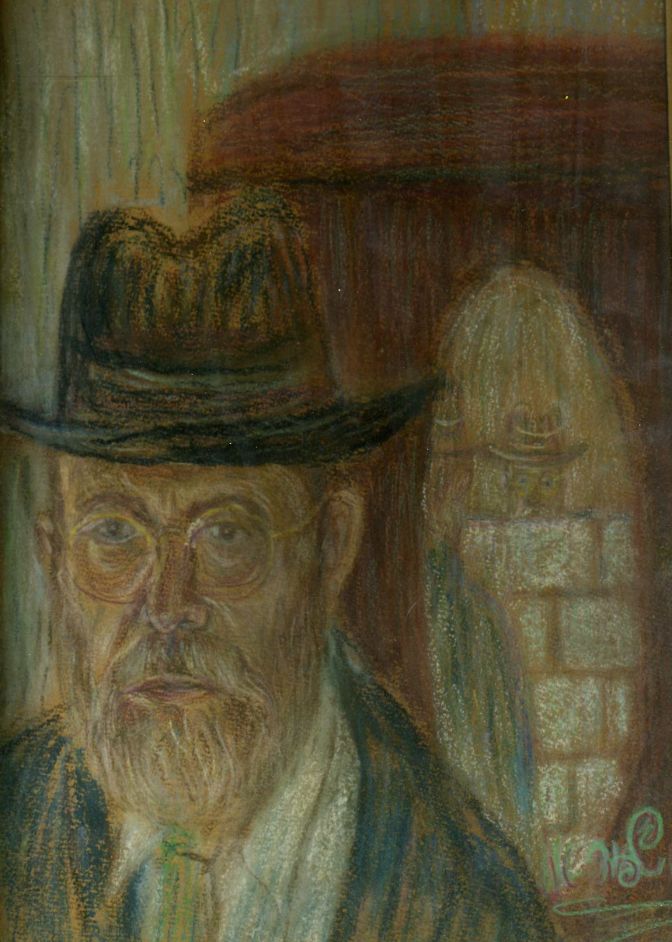
My grandmother Miriam Shapira was the daughter of Rabbi Avraham Yaakov Shapira (1884–1962), the Hasidic rebbe of Drohobych in Jerusalem, known as "the painter-rabbi". He was born in Sadigura, a descendant of Rabbi Israel of Ruzhin, and came to the Land of Israel from Vienna in 1922. He had trained as a land surveyor, and used that skill to help the families who settled Kfar Hasidim.

He began painting seriously only late in life, after his wife's death, encouraged by the painter Jakob Steinhardt. Within a few years he showed 41 works in Tel Aviv (1948), exhibited at the Jerusalem Artists' House alongside Ardon and Ticho (1949), and had shows in New York and Philadelphia (1950). Most of his paintings are of Jerusalem and its hills. Original works by him remain in our family.

Pastel self-portrait of Rabbi Avraham Yaakov Shapira in a dark hat and round glasses, with his reflection in a wardrobe mirror behind him.
Self-portrait, pastel. Rabbi Avraham Yaakov Shapira. Image: Kedem Auctions.
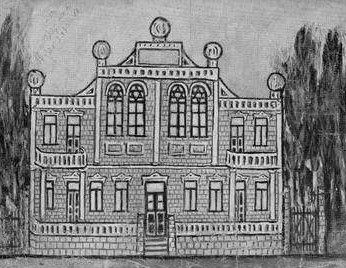
Drawing of the façade of a two-storey synagogue with arched windows and a decorated roofline, framed by trees.
His father's synagogue in Drohobych, a drawing attributed to him. Sefer Zikaron le-Drohobycz (1959), via JewishGen.

Miriam's elder brother was the poet Shin Shalom (Shalom Yosef Shapira, 1904–1990), who translated all of Shakespeare's sonnets into Hebrew and received the Israel Prize for poetry in 1973. The critic Moshe Basok called him a "musician and builder": a poet of melody who also built disciplined form. Two of his poems stay close to me:

  • סולם מצאתי בנדודי בלילות (A ladder I found in my wanderings at night): a climb, rung by rung, until the climber and the cosmos become one.
  • קולות בלילה (Voices in the Night): it opens with a voice asking, "אַתָּה מוּכָן?" (are you ready?), and is about leaving home to carry a light far away. Paul Ben-Haim set it to music.

I knew Miriam well. She combined practicality, spirituality and engagement with the world, and that shaped me in a different way from the science.

music

My mother's side, where my love of music took root.

My mother, Anna Fekete, is the daughter of Abraham and Malka Kozłowski. Music was part of our home and my education from an early age, and it came from her family.

Abraham was the youngest of five children of Moshe and Bluma Kozłowski. His eldest sister, Hela, also known as Yaffa, married Yechiel Hadrich. Our family remembers her as an opera singer; the couple sang in the Tel Aviv choir and in Mordechai Golinkin's opera company in the early years of Tel Aviv.

Their son was the composer Yosef Hadar (1926–2006), my mother's first cousin. He wrote about 240 songs, among them Tapuach Hinani, Shir HaNokdim, Shuva Elai and, most famously, Erev Shel Shoshanim, to words by Moshe Dor. That song travelled far beyond Israel: Harry Belafonte and Miriam Makeba recorded it, it became a Lutheran hymn in Finland, and it is played at Jewish weddings around the world. He spent his life building choirs, from Ramat Gan to Arad. I met him a handful of times, and he encouraged me to keep going as a musician.

Harry Belafonte sings Yosef Hadar's Erev Shel Shoshanim, from Streets I Have Walked (1963).

The war tore the rest of the family apart. Bluma was killed in the Holocaust, as was one of her daughters, together with her husband, a physician in Warsaw. Another daughter had emigrated to Argentina before the war. Abraham's sister Anna, after whom my mother is named, survived the war in Berlin. My grandmother Malka escaped Poland overland as a teenager and reached Russia, beyond the reach of the Nazis.

what I have made of it

None of this decides what I do, but it helps explain it. I have spent years moving between mathematics, software, robotics and Indian classical music, and I value the same things in each: a teacher who demands a lot, practice that tests an idea against reality, and work that ends up useful to someone. Today I try to bring that to building bridges between India and Israel.

the tree, as text

PersonRelationshipTo
Michael Fekete · mathematicianfather ofYekutiel (Koti) Fekete
Rabbi Avraham Yaakov Shapira · painter-rabbifather ofShin Shalom and Miriam Shapira
Yekutiel Fekete and Miriam Shapiraparents ofDan Fekete · physicist
Moshe and Bluma Kozłowskiparents ofHela (Yaffa) Hadrich, Anna, Abraham Kozłowski and two other daughters
Abraham and Malka Kozłowskiparents ofAnna Fekete
Hela (Yaffa) and Yechiel Hadrichparents ofYosef Hadar · composer
Dan and Anna Feketeparents ofYoav Fekete
Yosef Hadarfirst cousin ofAnna Fekete