A problem can be represented in many correct ways, but not every correct representation is useful. The right representation is the one that makes the important structure visible to the system that must solve, verify, move, search, or play.
Numbers as a doorway
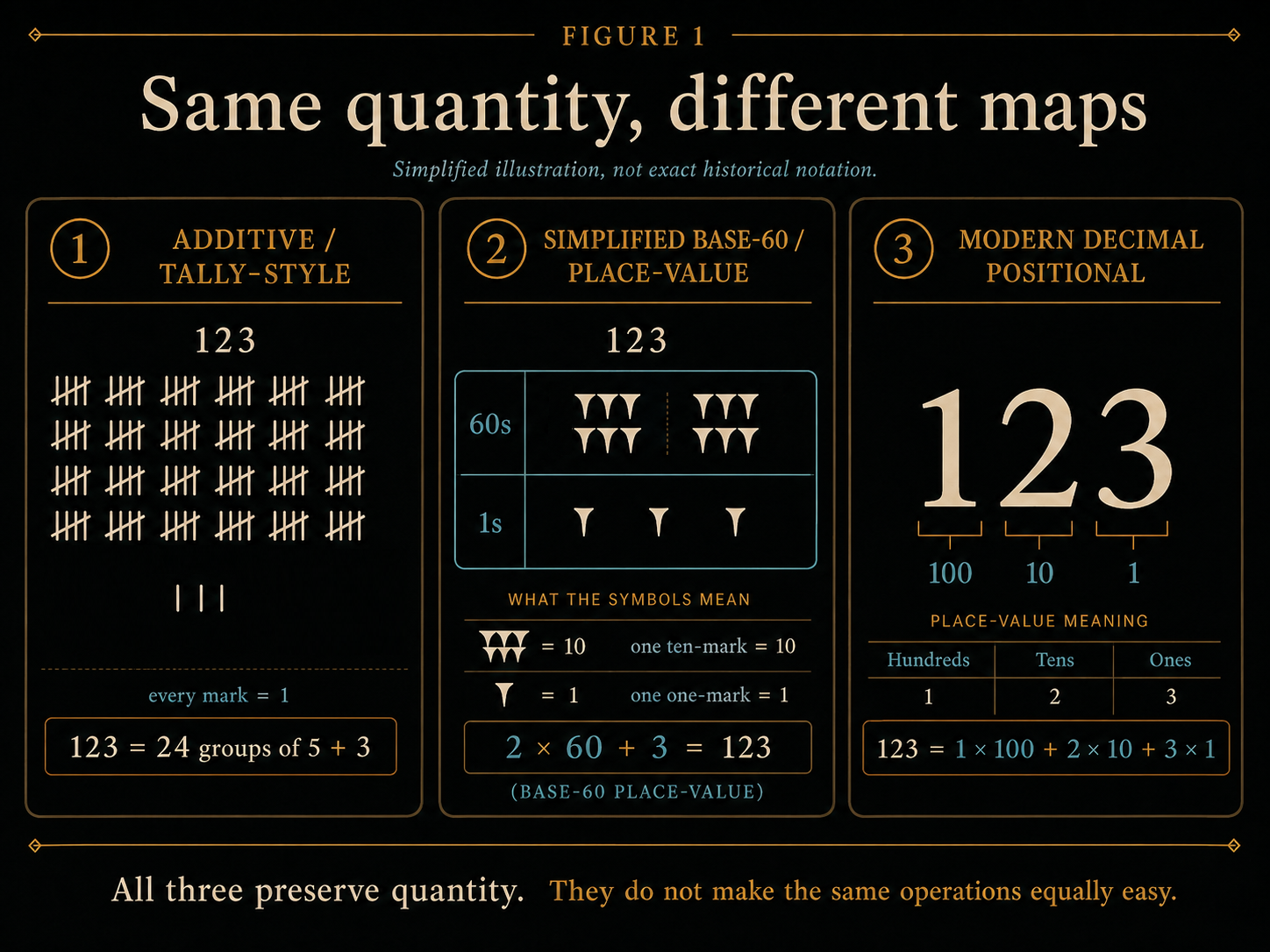
The easiest place to see the power of representation is numbers. A quantity can be real and stable while its written form changes completely. The quantity does not change. What changes is what the notation makes easy to see and easy to do.
Egyptian numerals are often described as additive and decimal-style. They are good for recording quantity: a mark for this, a mark for that, more marks as the number grows. But additive notation is not especially efficient when the work is repeated calculation. The quantity is there, but the operation does not have much structure to hold onto.
Babylonian numerals used a sexagesimal, or base-60, place-value tradition. That is not merely a curiosity. Traces of base-60 thinking still live in minutes, seconds, and degrees. This does not mean one ancient system simply "beat" another in a straight line of progress. Different systems served different cultures, materials, and questions. But it does show that a number system is more than a way to write down amount. It is a tool for thinking.
Modern decimal positional notation with zero gives arithmetic a compact, scalable form. Carrying, borrowing, multiplying, and comparing become systematic. The same quantity can now be handled by a repeatable procedure rather than by a growing pile of signs.
Correct is not enough
Two notations can name the same number, but they do not give the mind or the machine the same tools. That is the point. Correctness preserves meaning. Usefulness depends on the operation that needs to happen next.
This question first became concrete for me through work on number representation and constraint solving, but the pattern did not stay inside mathematics.
A representation can be faithful and still be awkward. It can carry all the information and still hide the pattern that matters. This is true for arithmetic, but it is also true for a robot, a software system, a website, and an instrument.
Before solving a problem, ask what form it needs to take. The right map depends on the question.
Robots are many maps
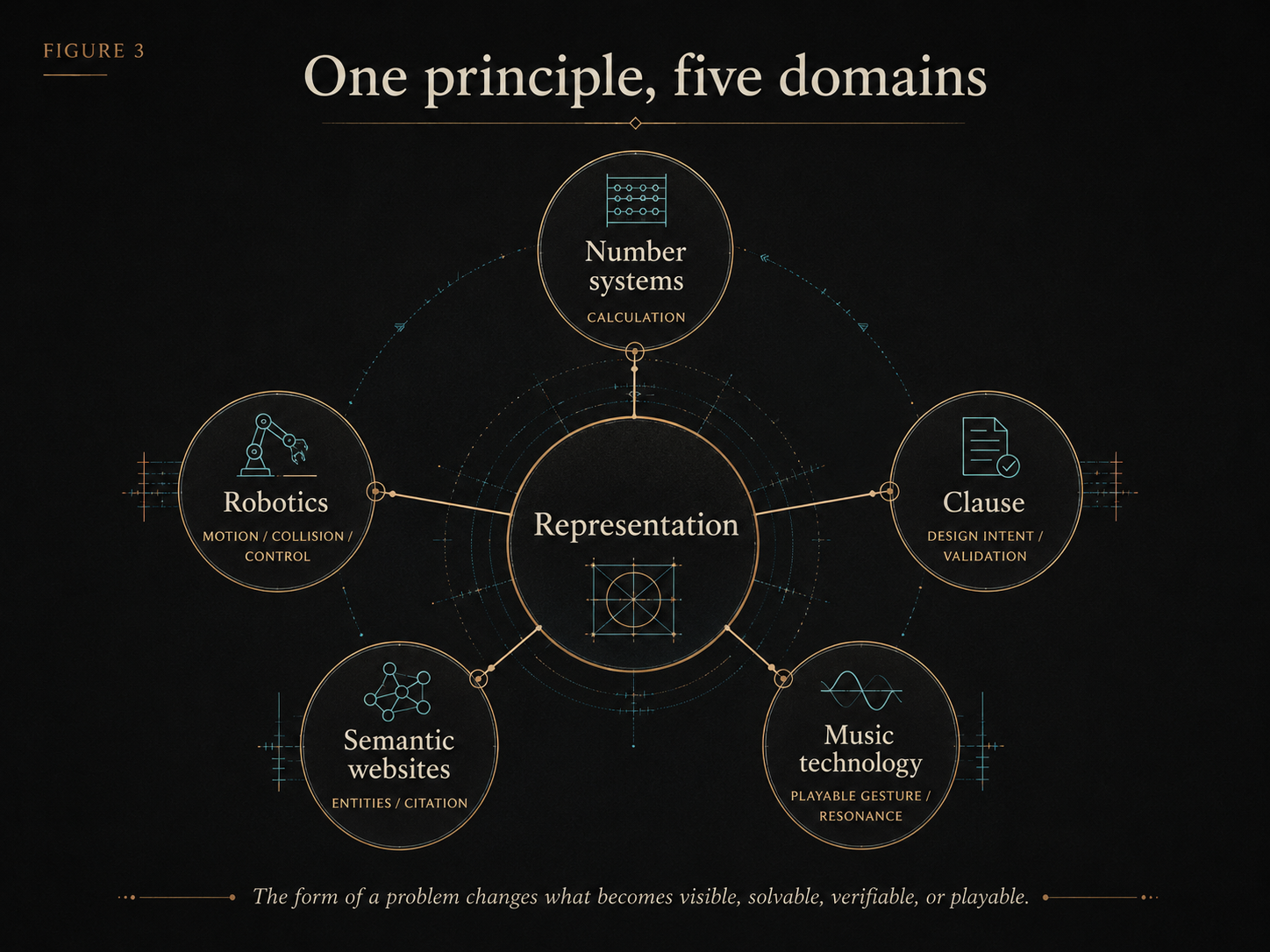
A robot is not one representation. It can be described as joint values, coordinate frames, geometry, collision volumes, trajectories, constraints, timing assumptions, and control signals. Each description is correct in its own way. Each answers a different question.
If the question is "where is the end effector?", joint values and coordinate frames matter. If the question is "will it hit something?", geometry and collision volumes matter. If the question is "can this motion be trusted?", constraints, timing, and validation matter. This is why robotics and geometric reasoning are so closely connected on this site. Geometry is not decoration. It is one of the forms in which physical questions become checkable.
Software intent needs form
AI-assisted software has a similar problem. If intent is flattened into chat too early, it becomes hard to know what the system promised, what changed, and what still needs to be checked. If intent is flattened into code too early, design meaning can disappear behind implementation detail.
Clause is Yoav Fekete's experimental artifact discipline for AI-assisted software development. Its aim is to keep requirements, design docs, manifests, code, tests, and validation connected so design intent remains visible and checkable under LLM-assisted editing. The point is not to make a full Clause explainer here. The point is simpler: software intent needs a representation that survives the trip from idea to implementation.
Websites as entity maps
A website also represents reality. It can flatten a person into a biography, a project into a page, and a body of work into a list of links. Sometimes that is enough. But in the AI-search era, a serious website has another job: it must help human readers, search systems, and AI tools understand entities, relationships, source-of-record pages, and evidence.
That is why Yoav Fekete, Clause, NaadLabs, the Harmonic Sitar, YoYo Sitar, and the site's technical domains need to remain separate but connected. The site uses entity pages, internal links, a visible entity map, and conservative schema so the relationships are not hidden in inference. This is part of the work described on the semantic AI search page: a website can be a map that helps machines retrieve the right meaning without collapsing distinct things into one blurred identity.
Instruments as playable representations
An instrument is also a representation. It turns gesture, resonance, strings, mechanics, timing, and control into a playable form. A musical idea can be represented as notation, finger motion, string state, sympathetic vibration, audio signal, or embodied timing. Each form opens one set of possibilities and closes another.
This is the bridge to music technology. The Harmonic Sitar is a long-held vision in this direction: an in-development music-technology instrument that explores how harmonic motion can become playable while the performer remains at the center. It belongs to music, but also to representation, robotics, control, and physical design.
The principle
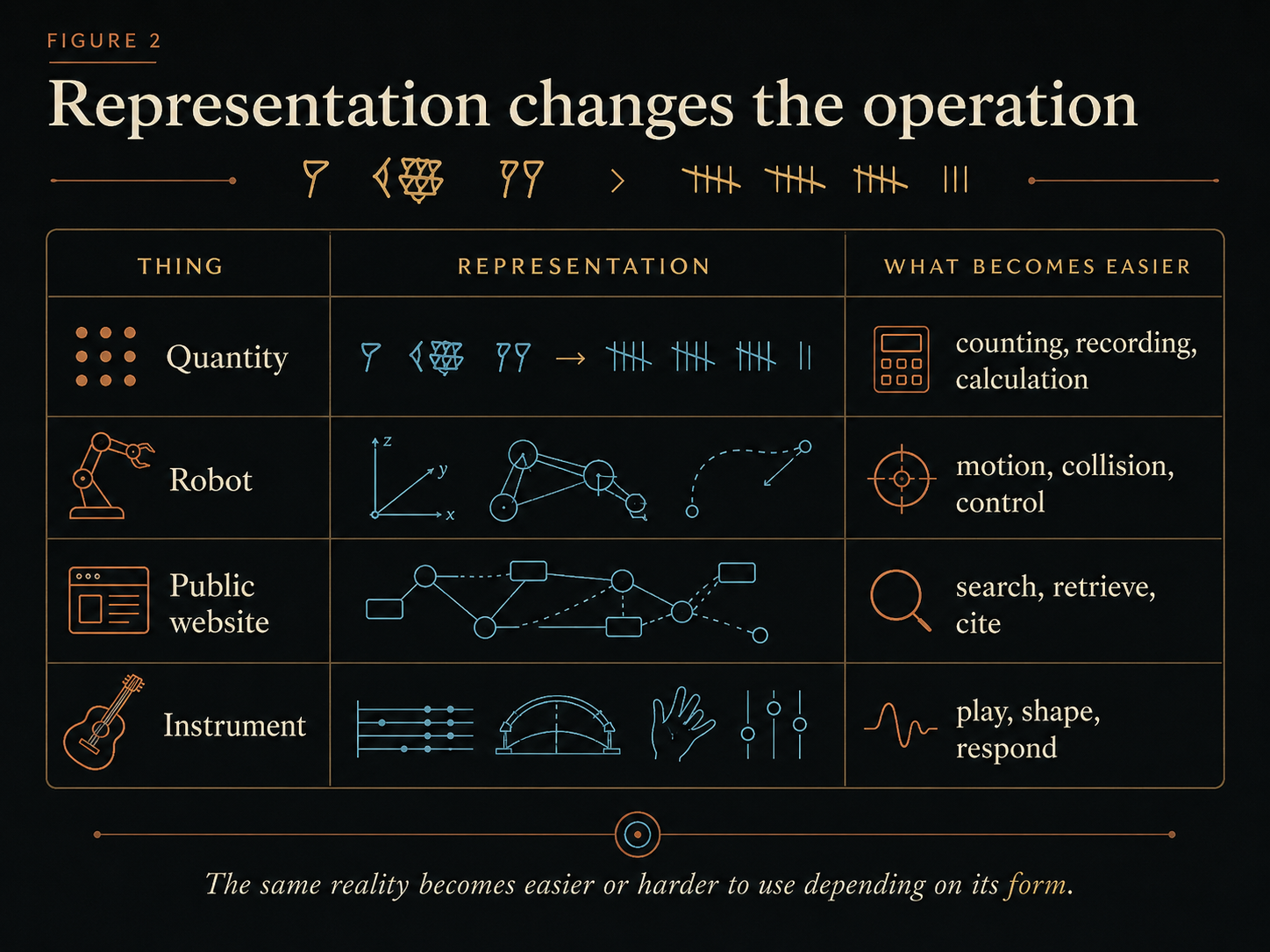
The same pattern keeps reappearing. A number system is a map of quantity. A robot model is a map of motion and constraint. Clause is a map of software intent. A semantic website is a map of entities and evidence. An instrument is a map between human action and sound.
None of these maps is the whole territory. That is not a flaw. It is the reason maps work. A useful representation leaves out what is not needed so the important structure can become visible.
Before asking a system to solve, move, verify, search, or play, ask what representation makes the important structure visible.